
Before visiting Bwindi Impenetrable Forest, I knew the forest for what most visitors know it for.
Mountain Gorillas.
Ancient trees.
Mist-covered mountains.
One of the most remarkable forests in Africa.
But there is another story here. A story about people.
Long before Bwindi became a National Park, before tourists arrived to trek through the forest in search of Mountain Gorillas, the forest was home to the Batwa.
They lived there for generations as hunter-gatherers, moving through the forest and depending on it for food, medicinal plants, materials, shelter and much of their cultural life.
Today, many Batwa live just outside the forest.
And they cannot go home.
A forest that was home
The Batwa are an indigenous tribe of the Great Lakes region of Central Africa. In southwestern Uganda, their traditional territories included Bwindi, Mgahinga and Echuya. They are widely regarded as among the region’s original inhabitants and are often described as a Pygmy people because of their historically small average stature.
Their relationship with the forest was not simply economic.
The forest was where they lived.
It was where knowledge was passed from one generation to the next. Where children learned which plants could be eaten, which could be used as medicine, where animals could be found and how materials could be collected.
The forest provided food and shelter, but also formed part of their identity and culture.
For generations, this way of life continued even as governments began formally designating parts of the forest as reserves.
The Batwa continued to regard the forest as their home and continued to use it.
Then, in 1991, Bwindi Impenetrable Forest and Mgahinga were established as national parks.
The Batwa were excluded from the forests that had been their traditional home.
The intention behind the creation of the parks was conservation. Protecting forests and some of the world's last remaining Mountain Gorillas among other species.
But protecting the forest changed the lives of the people who had lived there.
And this is where the story becomes much more complicated.
Conservation has a human side
There is no question that Bwindi is an extraordinary place.
The forest is enormously important for biodiversity. It contains Mountain Gorillas, Eastern Chimpanzees, African Forest Elephants, numerous primates, birds, butterflies and countless plant species.
Protecting such a place matters.
But conservation does not happen in a vacuum.
A forest can be protected from logging and agricultural expansion while the people who depended on that forest lose their livelihoods.
The creation of the national park meant that the Batwa could no longer freely hunt, gather food, collect medicinal plants or use the forest in the way their ancestors had done.
For a community whose knowledge and livelihood were built around the forest, suddenly being outside it was not simply a change of address.
It meant learning an entirely different way of living.
From forest to farmland
The transition was particularly difficult because the Batwa were not traditionally agriculturalists.
The forest had provided many of their needs.
Outside the forest, however, food had to be bought or grown.
Land had to be found.
Money became important.
Employment became important.
And suddenly a community with generations of knowledge about living in the forest had to operate within an economic and social system that was largely unfamiliar to them.
Research into food security among Batwa communities in Kanungu found extremely high levels of food insecurity and described the difficulties of moving from forest-based livelihoods to agriculture without the necessary land, experience and resources.
For some families, the result was landlessness.
For others, casual labour became an important source of income.
Some came to depend on assistance from NGOs, trusts and other organisations.
The forest had once provided much of what they needed.
Now, many of those things had to be obtained with money.
What does displacement really mean?
It is easy to understand displacement as losing a piece of land.
But imagine losing an entire landscape.
The places you know.
The paths you grew up walking.
The plants you know how to use.
The places where your grandparents taught you something.
The trees associated with stories.
The caves and streams.
The animals.
The sounds.
The knowledge accumulated over generations.
Then imagine that your children grow up somewhere else and never experience the place that was home to their grandparents.
That is a different kind of loss.
It is not only physical.
It is cultural.
And it is generational.
A minority outside their own forest
Today, the Batwa remain one of Uganda's most marginalised minority communities.
Access to education and healthcare remains difficult in many communities, and studies have documented discrimination in schools and health facilities as well as broader social and economic marginalisation. Uganda's National Forestry Authority has reported that more than half of Batwa people have no formal education, with discriminatory behaviour and poverty among the factors affecting educational attainment.
The problems can begin very early.
Children may encounter stigma from other pupils.
Families may struggle to afford school materials or food.
Health centres can be far away, particularly for communities living in remote mountainous areas.
And even when services exist, discrimination and poverty can make accessing them more difficult.
This creates a difficult cycle.
Limited education can mean fewer employment opportunities.
Limited employment means poverty.
Poverty makes education and healthcare harder to access.
And discrimination can make all of these problems worse.
For a community that was already displaced from its traditional livelihood, the consequences can continue long after the original eviction.
And then there is the forest knowledge
One of the saddest contradictions is that some of the people who know the forest best are now the people who are least able to live in it.
Batwa elders have an enormous body of traditional knowledge about the forest: Its plants, animals, trails, materials and cultural places.
Research at Bwindi has documented how Batwa elders were able to demonstrate the depth of this knowledge when they were brought into discussions about conservation and park management. In some cases, this knowledge has even been incorporated into cultural interpretation and tourism programmes.
That raises an interesting question.
If a forest is worth protecting partly because of its extraordinary ecological value, should the knowledge of the people who lived there for generations also be considered part of that heritage?
Perhaps conservation does not have to mean choosing between forests and people.
Perhaps there are ways of protecting both.
The visit I will remember
When I visited a Batwa community near Bwindi, we were shown how people live today.
The houses were extremely basic.
In some, there was little more than a floor to sleep on, a place to cook and a few possessions.
It was difficult not to compare it with what the forest had once provided.
We were shown aspects of Batwa culture and history.
There was singing.
There was dancing.
There were demonstrations of traditional skills.
For a visitor, this can be fascinating.
But I found myself wondering about something else.
What does it feel like to have to demonstrate parts of your own culture because visitors are willing to pay to see them?
There is an uncomfortable side to cultural tourism.
It can provide income.
It can preserve traditions.
It can give communities a way to tell their own history.
But it can also turn something deeply personal into a performance.
The difference depends largely on who controls it, who benefits from it and whether the people themselves have a meaningful voice in how their culture is presented.
A different kind of tourism
Tourism has nevertheless become an important source of opportunity for some Batwa communities.
Cultural experiences allow visitors to meet Batwa community members, learn about their history and see demonstrations of traditional knowledge. Properly structured, these experiences can provide direct income and help keep cultural knowledge alive. Existing programmes around Bwindi and Mgahinga have been designed specifically to generate income and support community projects.
But there is a strange irony here.
The forest was taken away partly in the name of conservation.
The gorillas became one of Uganda's most valuable tourism attractions.
Visitors from around the world now come to Bwindi to experience the forest.
And some Batwa families now earn money by showing visitors aspects of the culture that grew out of their former life in that same forest.
Tourism can therefore be part of the solution.
But it should not become the only solution.
A community should not have to dance for tourists in order to have a place in the conservation story.
The question I could not forget
During our visit, I had the opportunity to speak with one of the elderly women in the community.
She was introduced to us as a Queen. A respected leader within her community. And a truly beautiful woman as well!
I asked her a very simple question.
After all these years, if she were allowed to return to the forest and live there again, would she go?
Her answer came immediately.
Yes.
There was no hesitation.
No long explanation.
Just yes.
I remember that answer because it made the entire story suddenly very simple.
Not politically.
Not legally.
Not scientifically.
Humanly.
For her, the forest was still home.
More than fifty years could not change that.
The generation that remembers. and the generation that doesn't
For older Batwa people, the forest is a memory.
For younger Batwa, it can be something they have only heard about.
They have grown up outside.
They may never have slept beneath the forest canopy.
They may never have followed the paths their grandparents knew.
They may know the stories without knowing the landscape in which those stories were created.
This is how cultural knowledge can slowly disappear.
A forest can remain standing while a culture connected to that forest gradually loses the ability to pass itself on.
And perhaps this is one of the less visible consequences of conservation.
We are very good at measuring trees.
We count gorillas.
We monitor chimpanzees.
We measure forest cover.
We record bird species.
But how do we measure what happens when a people lose the landscape that shaped their culture?
Were the gorillas worth protecting?
I don't think this is the right question.
The Mountain Gorillas of Bwindi needed protection. They needed it very much. And I am very happy that they are once again thriving in this ancient forest. One of the most beautiful places I have ever been lucky to visit.
The forest needed protection.
The biodiversity of Bwindi matters enormously.
But perhaps the question should be broader:
How can we protect a forest without forgetting the people who once called it home?
The history of conservation contains many examples where protecting nature meant restricting or removing people.
Sometimes the ecological argument was compelling.
But conservation has increasingly had to confront the human consequences of those decisions.
Today, there are efforts to improve Batwa access to education, healthcare, land and economic opportunities, as well as programmes designed to involve Batwa knowledge and culture in conservation and tourism. But significant inequalities remain.
The story is therefore not finished.
The people behind the attraction
For most visitors, Bwindi has one great attraction.
The Gorillas.
And rightly so.
Standing in the forest with a Mountain Gorilla is an experience that is almost impossible to describe.
But before the gorillas became the reason people travelled to Bwindi, there were people who knew these forests intimately.
People who knew where to find food.
Which plants could heal.
How to move through the forest.
Where animals travelled.
Which places were important.
People whose culture developed within the forest rather than simply around it.
Today, they live at its edges.
Some have land.
Some do not.
Some work.
Some depend on casual labour.
Some have access to education.
Many still face barriers.
And some make a living by welcoming visitors and showing them a small part of a culture that was once simply their everyday life.
They are not merely another stop before the gorilla trek.
They are part of the history of Bwindi.
And perhaps that is what I would like visitors to remember.
When you travel to Bwindi, you are not only entering a forest that needs protecting.
You are entering a landscape with a human history as deep as its ecological one.
A history that includes loss.
A history that includes resilience.
And a people who, despite being separated from their forest for generations, still remember it as home.
Perhaps conservation has done an extraordinary job of helping the forest survive.
The next challenge is making sure that the people who once called it home are not forgotten while it does.
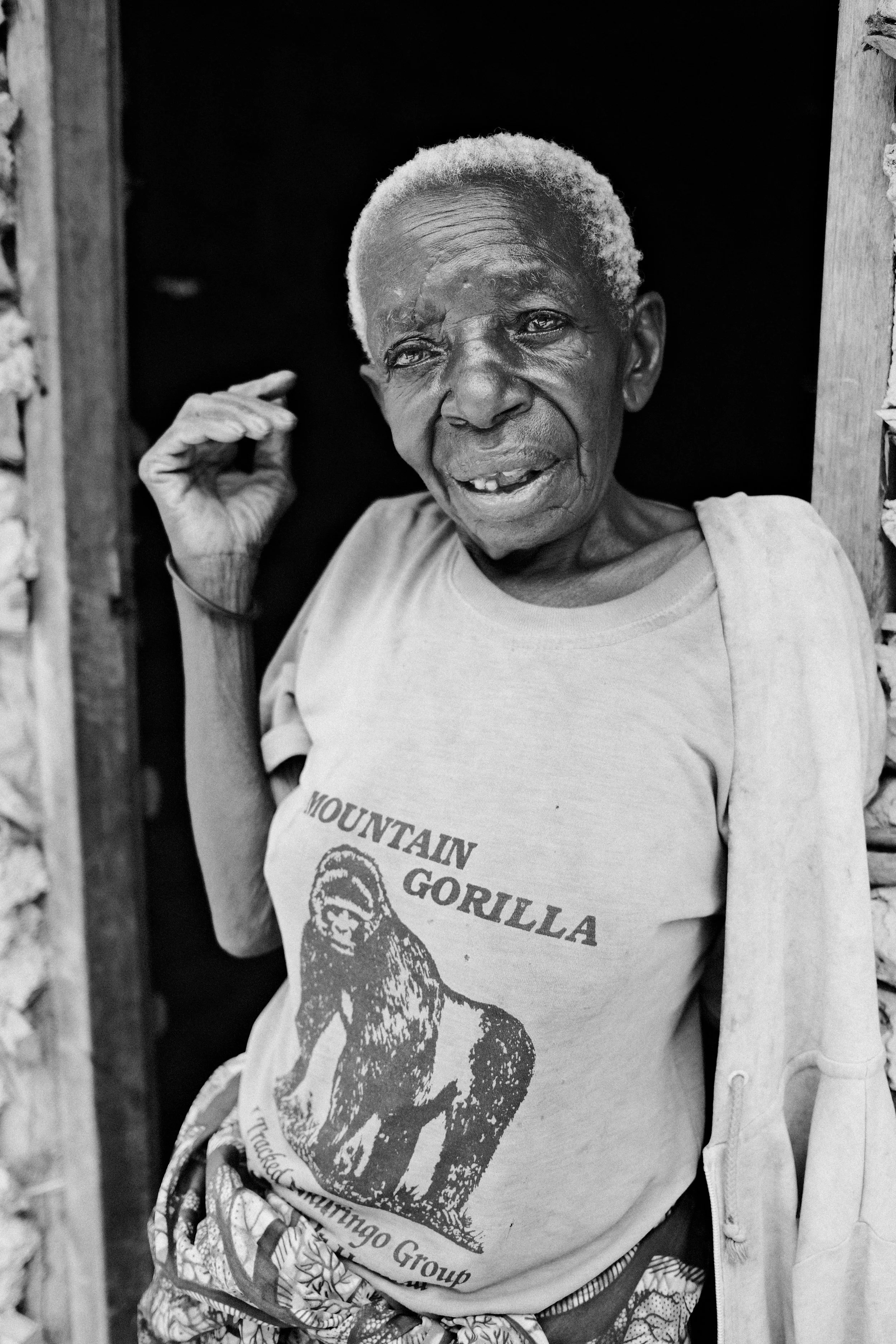
THE BATWA QUEEN
